Measure the net area before adding a buffer
A 12 × 10 ft rectangular room has a floor area of 120 ft². If the floor has a recess or an L-shaped extension, split it into non-overlapping rectangles and add those areas. Keep that measured net area separate from any extra material you intend to buy.
When combining several rooms that use the same flooring, add their net areas first. This site’s calculator handles one rectangle at a time; it is not a cutting-layout optimizer. A hand-drawn plan is still useful for deciding plank direction and identifying the small cuts that may be difficult to reuse.
Choose the allowance for the actual product and layout
The default allowance is 10%. Lowe’s wood and laminate project planner uses a 10% allowance as a planning example, but that does not make it correct for every material or layout. Follow the instructions for the specific product and check the installer’s plan.
Diagonal runs, patterns, narrow strips, damaged pieces and room geometry can affect how much extra material is appropriate. An allowance is an input to the estimate, not evidence that a particular layout will fit.
With the example 120 ft² room and a 10% allowance, the required area is 120 × 1.10 = 132 ft². Apply this percentage once. Do not add the same waste allowance to every measurement and then add it again to the total.
Round up after dividing by the box coverage
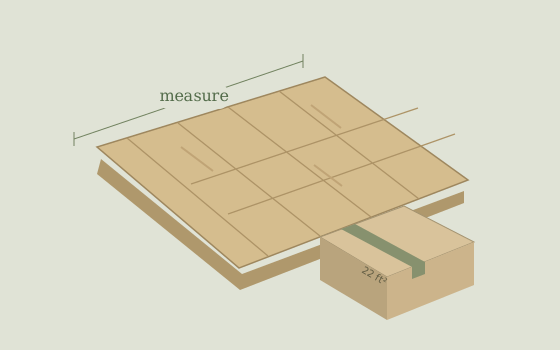
Read the coverage of the exact box you are buying. If each box covers 22 ft², 132 ÷ 22 = six boxes. If it covers 20 ft², 132 ÷ 20 = 6.6, so the purchase is seven boxes, or 140 ft².
Whole-box rounding can add material beyond the percentage you selected. It is helpful to display both the required area and the purchased area. For the seven-box example, purchased area minus net room area is 20 ft². That figure contains the planned cutting allowance as well as the package remainder.
Some material becomes cut waste. Some may remain usable. A quantity calculator cannot tell you how much of each without a real layout.
Price the whole boxes and keep extras separate
Multiply the number of boxes by the price per box. Six boxes at an example $48 each gives $288 in flooring material. The price in the calculator is editable and is not a live retail quote.
Underlay, adhesive, thresholds, edging, delivery, tax and labor are not part of this number. List them separately if you are building a project budget. Changing the currency selection only changes the display symbol; it does not convert prices using an exchange rate.
Before ordering, confirm the package coverage, product instructions and return policy with your supplier. Keep your original measurements so the estimate can be checked when the product or layout changes.
References & further reading
Manufacturer and retailer references inform the product context. The worked examples and calculator formulas are our own explanations.