Start by counting strips across the wall
Divide the wall width by the actual roll width and round up. A 3.5 m wide wall with 53 cm wide wallpaper needs 3.5 ÷ 0.53 = 6.60 widths, so plan for seven complete strips. The last strip may be cut narrower, but it still uses a length from the roll.
Our calculator plans one rectangular wall. It does not deduct windows and doors: the cutting plan around an opening may use offcuts, but simply subtracting opening area does not tell you how many full-height lengths remain necessary.
Use the actual dimensions of the package you intend to buy. A product described as a double roll should be entered using that package’s full usable length and price. The calculation does not interpret marketing names.
Then work out the usable cut length
For random-match wallpaper, start with wall height plus the combined top and bottom trimming allowance. An 8 ft wall with 4 in total trim needs a cut of 8 ft 4 in before considering patterns.
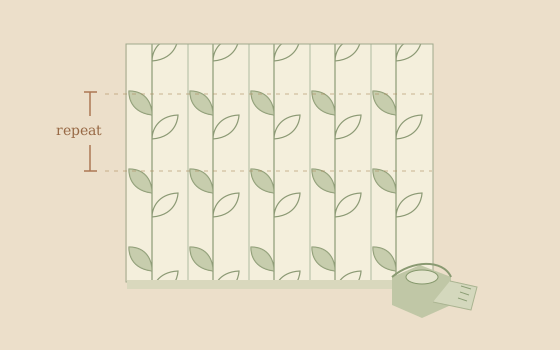
For a straight match, this planner rounds that cut length up to a whole pattern repeat. With a 24 in repeat, the same strip is rounded from 100 in to 120 in: a 10 ft cut. The extra length is part of matching the pattern, not extra wall height.
Graham & Brown distinguishes straight matches from offset matches. Offset, half-drop and alternating A/B designs need a different plan. This calculator does not support those layouts. It also assumes the roll starts at a usable pattern position; aligning the first pattern can consume additional length in a real roll.
A worked example where area alone falls short
Take the 3.5 m wide wall above at a height of 2.4 m. The roll is 0.53 m wide and 10 m long. Add 10 cm of combined trim. With a 64 cm straight-match repeat, 2.5 m rounds up to four repeats, giving a 2.56 m cut length.
Each 10 m roll supplies floor(10 ÷ 2.56) = three complete strips. Seven strips therefore require three rolls. Dividing wall area by roll area gives 8.4 ÷ 5.3 = 1.58, which would round to only two rolls. The missing detail is the short remainder on each roll.
Two leftover lengths do not automatically make one usable full-height strip. This estimate treats each roll separately and does not assume invisible joins or reusable offcuts.
Check the product before placing the order
Confirm the match type, repeat, actual roll dimensions and supplier instructions. A mural with fixed panels is a different product from a repeatable roll and does not fit this model. Large patterns, focal points, awkward corners and the first pattern alignment can all change the cutting plan.
The extra-rolls field adds a stated number of whole rolls after the calculation. It is not an automatically chosen percentage. Check the supplier’s own roll calculator and batch guidance, and ask for a layout check when the pattern falls outside a random or straight match.
The visual diagram and numbers here explain the geometry. They do not claim that this particular wallpaper has been installed or tested by the site.
References & further reading
Manufacturer and retailer references inform the product context. The worked examples and calculator formulas are our own explanations.